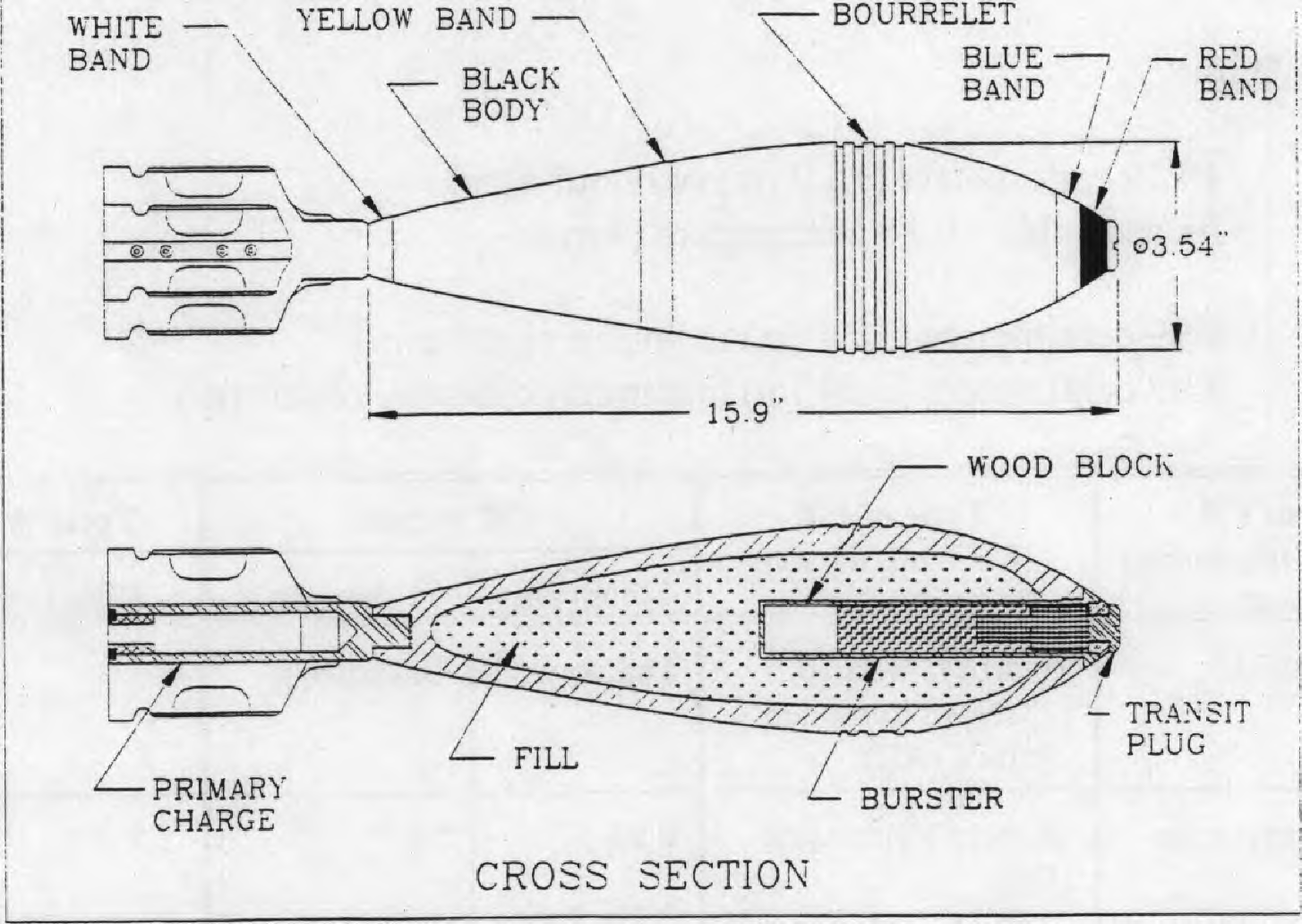
Description
The 90 millimeter mortar had two types of projectiles: (1) a bursting, container type and (2) a annular cavity type. The difference between these two projectiles was the length of the forward and rear sections of the body. The long type was constructed of steel, while the short type was made of semi-steel.
The Type 95 was similar in design to the Type 94, 90 millimeter HE mortar projectile, with the following exceptions:
-- An enlarged booster cup threaded into the nose of the projectile. It contained a well for the lower fuze body and detonator, a burster charge, and a wood block.
-- A fuze adapter threaded into the forward end of the booster cup.
The Type 94 Mortar Projectile had a burster tube that screwed internally into the nose adapter, which in turn screwed into the body. There were three gas check rings. The tail unit threaded into the body and was retained by three crimps. The tube of the tail unit contained 24 holes arranged in 6 vertical rows of 4 each. Three brackets forming six tail fins were spot-welded to the tube. The tail arrangement was designed for one primary and six secondary charges.
Functioning
No information about functioning.
Hazardous Components
No information about hazardous components.
See Also
Source(s)
Old Chemical Weapons Reference Guide (1998)