Description
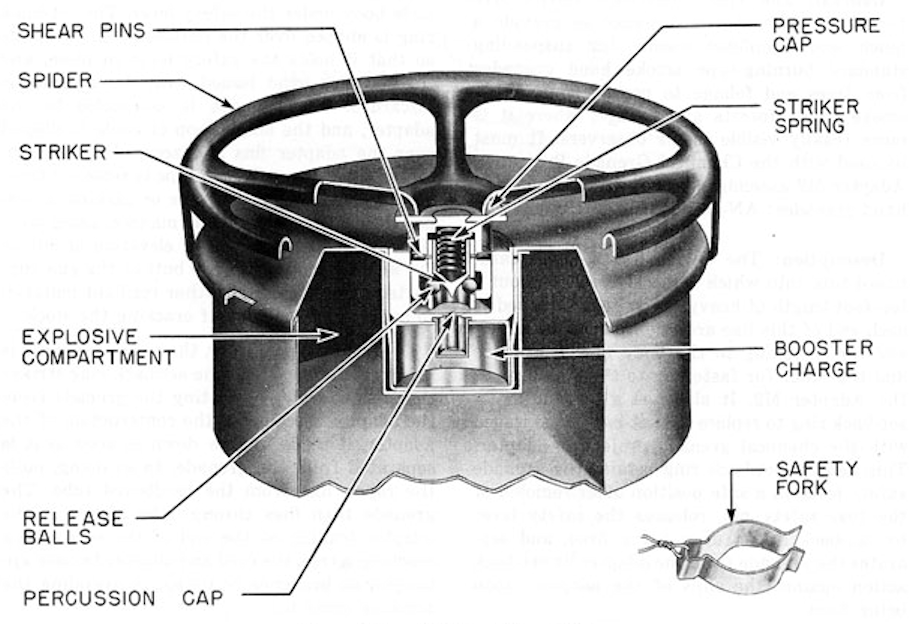
The metallic Anti-Tank Mine M1A1 has three main components: loaded body, fuze, and spider. The spider fits over the fuze to increase the effective size of its head. The steel body is a squat cylindrical container of light steel filled with high explosive. A carrying ring is attached to its side. The flanged rim around the top is notched for attaching the spider. In the center of the top is the cavity for the fuze and booster; the booster fits into the cavity and locks into place. The spider is a ring with two cross members pressed from a single sheet of metal. Hooks on the spider engage the flange on the mine body, and the center hub of the spider rests on the striker head of the fuze. When the mine is packed, the spider is placed over the bottom of the steel body to save space.
The bottom and inch of the side are painted yellow; the rest of the mine is painted olive drab.
The principal difference is that, in the Mine M1, the booster is an integral part of the fuze; in the Mine M1A1 the booster is a separate part and issued assembled in the fuze cup of the mine.
Functioning
The safety fork is not removed until after the mine is laid; and, after removal, the fork is left beside the mine, attached to its cord, never between the body and the spider. Before the mine is taken up, the safety fork is replaced.
See Also
Source(s)
OP 1664, Volume 2 - US Explosive Ordnance (1947)
TM 9-1904, Ammunition Inspection Guide (1944)