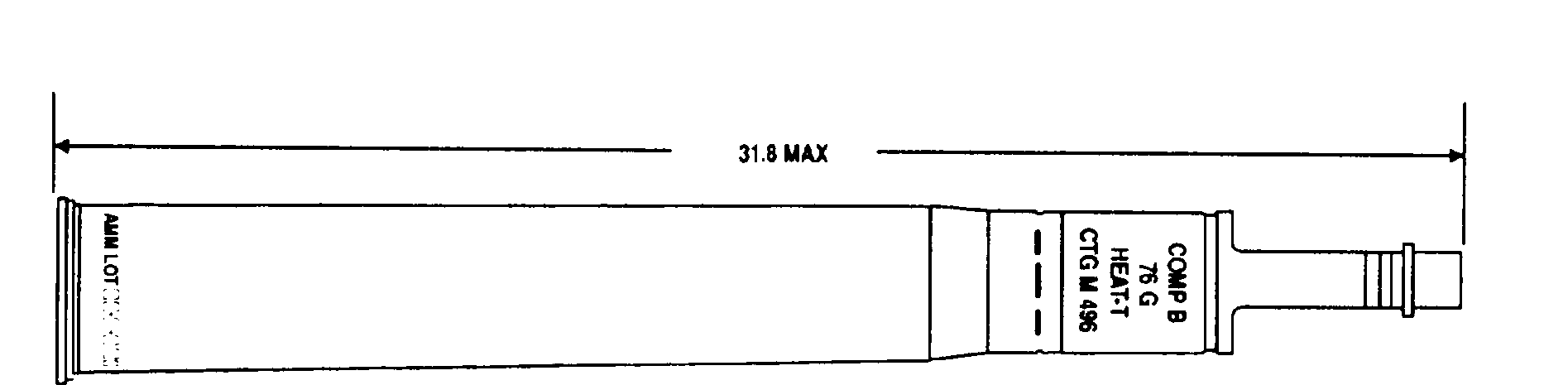
Description
This fixed ammunition cartridge is used in 76mm gun cannons against heavily armored targets.
The projectile is a hollow, steel shell tapered at the rear and fitted on the nose with a standoff spike containing a piezoelectric element. The shell is filled with high explosive fitted around an internal copper cone. The apex of the cone is to the rear, thus shaping the charge. The base of the projectile is closed by an adapter which also provides a seat for the fuze. A boom and fin assembly is assembled to the adapter (for stabilization in flight) and a tracer element is located in the fin assembly. A point-initiating, base-detonating (PIBD) fuze is located in the adapter. A brass cartridge case containing a single-base propellant and a percussion primer is crimped to the projectile. A distinguishing characteristic of these rounds is the cartridge case-over-band construction. The specially designed rotating band has a crimping groove which permits the cartridge case to be assembled over the rotating band and rigidly crimped to it.
The projectile is black with white markings and a yellow band.
Functioning
When the weapon is fired, flash from the primer ignites the propellant. The burning propellant ignites the tracer and generates gas to propel the projectile from the gun barrel. The boom and fin assembly provides stability in flight and the tracer provides a visible trace of the trajectory. Upon impact, the piezoelectric element in the standoff spike initiates functioning of the PIBD fuze. The fuze detonates the explosive charge and causes the copper cone to collapse, creating a high velocity shock wave and a jet of metal particles which penetrate the target.
Hazardous Components
Filler - Composition B (1.1 lb, 0.5 kg)
Cartridge case - M171A1
Propelling charge - M6 (5.06 lb, 2.3 kg)
Primer - M81 percussion
Tracer - M13
Physical Data
Length, overall - 31.8 in, 807.7 mm
See Also
Source(s)
TM 9-1300-203, Artillery Ammunition (1967)